

Under His Shadow
Bezalel and the Marian Tabernacle

This is an essay I wrote a number of years back but never published. On this, the Feast of the Annunciation of the Blessed Virgin Mary, I share it with you in hopes that it will nourish your piety and increase your joy on the celebration of such a cosmically important moment!
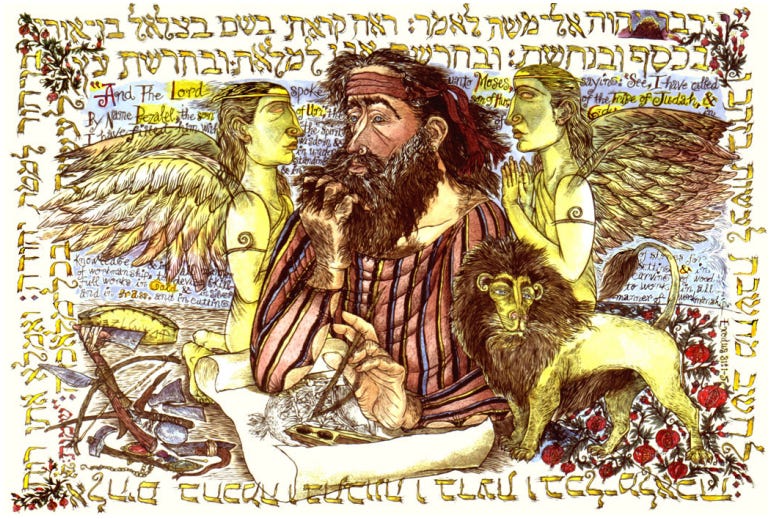
Introduction
It’s not often that one stumbles across biblical connections that they have never before seen made. Especially if one is a theology and/or Church history enthusiast, it can be exhilarating to unearth fresh typology and find that it holds up under the light of continued research. On the flip side, one wonders, “Surely I can’t be the first to see this? Am I making it all up? Am I a heretic?” As far as I can tell, I am the first to present the main idea of this essay. I would be happy to be proven wrong, so please let me know if you have encountered the same idea elsewhere.
In spite of my best efforts, the only other person that I have found to make any connection between Bezalel and Mary is the artist and author Christ (rhymes with “wrist”) John Otto, who speaks particularly to artists about creativity and art. If he addresses elsewhere what I am about to present in what follows, then I am ignorant of it.
The title of this essay alone may raise a series of questions: Who is Bezalel, exactly? What is their connection to Mary? Mary didn’t build a tabernacle, did she? What does the tabernacle have to do with any of it? These are good questions that deserve good answers, and I shall give answers in due course. It remains to be seen whether they are good or not.
The Gospel According to St John
But before I can give any answer at all, I must lay the groundwork for my argument, or rather point to the one who has already begun laying it for me: St John the Apostle.
St John and his writings serve as the jumping-off point for this essay, particularly his Gospel of Jesus Christ. John is unique among the apostles not only for his privileged status as “the disciple whom Jesus loved”, but also for his long life which seemed unnatural compared to the lives of the other apostles, cut short as they were by martyrdom. He had many years to contemplate and sit with the teachings of his Divine Lord, meditating on the Law and the Prophets in light of what Jesus revealed in His Person and teachings. This uniqueness is reflected in his gospel where he explores temple themes — it’s worship and it’s priesthood — in relation to Jesus’ life, even going as far as fiddling with the precise chronology of events, the ordering and timing of which are more or less agreed upon in the Synoptic Gospel accounts (i.e. Matthew, Mark, and Luke), in order to articulate his matured theological insights.
He wastes no time diving right into what will prove to the discerning reader to be the paradigmatic statement of his book at 1:14, “And the Word became flesh and dwelt among us, and we have seen his glory…” I am assuming along with all of historic Christianity that the Word here is a reference to Jesus. What isn’t immediately evident to the English-only reader of the Bible is the little word dwelt. When you read this short verse, it may rightly take your mind back to St Luke 1-2, to the Incarnation of God the Son in human flesh — as indeed our text here does say that the Word became flesh.
But what of dwelt? This term is not chosen by accident, and it does not simply convey the English dictionary definition of “to live or continue in a given condition or state”. It is the Greek verb σκηνόω (skenoō), “to tabernacle”, and it is derived from the noun σκηνή (skené), “tent, tabernacle”. The verb form, used only by John both here in his Gospel and again in his Revelation, would be roughly equivalent to saying “dwelling in one’s tent”. John is telling us, then, that Jesus “tabernacled” or “dwelt in His tent” amongst humanity, that God the Son took up residence in our human flesh and dwelt among us as one of us. The Beloved Apostle has a very precise concept he is articulating here: Jesus is the σκηνή, the Tabernacle.
Tabernacle
What is the Tabernacle? In the book of Exodus beginning in chapter 25 and going clear through to the end of chapter 30, God gives in exacting detail the precise dimensions, textiles, contents, decorations, instruments, and occupants of an elaborate tent called “the Tabernacle”. This tent would serve as the the location in which God’s manifested Presence would dwell and be accessible to His priests and to Moses during Israel’s wilderness wanderings.
And this raises an underlying question: Why would the uncontainable God choose to contain Himself in a tent in the desert with a kingdom of people who were tenuously loyal to Him at best? The resounding answer of Scripture is: Because He wanted to.
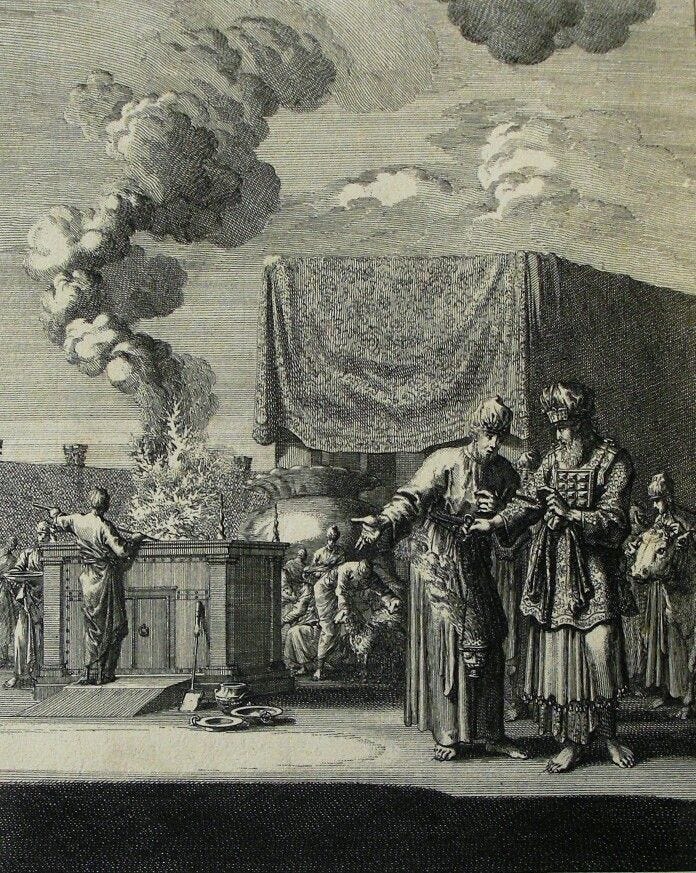
From the Garden onward we are both shown and told of God’s desire to be with His creation, filling it with His presence and enjoying all that His hands have made. From His meetings with Adam in the cool of the day and His distress that Adam had missed this regular time of fellowship (Gen. 3:8-9); to his explicit statement in Exodus 29 while giving the tabernacle’s construction blueprints that I will dwell among the sons of Israel and will be their God; to a later statement through the prophet Ezekiel that my dwelling place also will be with them (Ez. 37:27); to John’s statement in his Gospel account that Jesus tabernacled with us; to the finale of Scripture in Revelation where a voice from the throne of God triumphantly declares Behold, the tabernacle of God is among men, and He will dwell among them, and they shall be His people, and God Himself will be among them (Rev. 21:3).
This is only a small sampling of God’s expressed desire to be with humanity, a desire both manifested and realized when God took human flesh in Christ and dwelt among us and, fulfilling His word through the prophets, was called Emmanuel: God with us.
The Tabernacle, then, is a focal point of the Old Testament period, particularly from the time of Moses to the construction of Solomon’s Temple. If you are an Israelite wandering through the wilderness post-Egyptian captivity and you want to go to meet God, there’s only one place for you to go: the Tabernacle. We could say that it is the place where heaven meets earth. From there God’s heavenly reign is made known and exercised in the world.
Before God’s presence can fill this Tabernacle, there must be a Tabernacle. Who will build it?
Bezalel
In Exodus 31 we are given the answer. It is worth quoting at length:
See, I have called by name Bezalel the son of Uri, son of Hur, of the tribe of Judah, and I have filled him with the Spirit of God, with ability and with intelligence, with knowledge and all craftsmanship, to devise artistic designs, to work in gold, silver, and bronze, in cutting stones for setting, and in carving wood, to work in every craft. And behold, I have appointed with him Oholiab, the son of Ahisamach, of the tribe of Dan. And I have given to all able men ability, that they may make all that I have commanded you: the tent of meeting, and the ark of the testimony, and the mercy seat that is on it, and all the furnishings of the tent, the table and its utensils, and the pure lamp stand with all its utensils, and the altar of incense, and the altar of burnt offering with all its utensils, and the basin and its stand, and the finely worked garments, the holy garments for Aaron the priest and the garments of his sons, for their service as priests, and the anointing oil and the fragrant incense for the Holy Place. According to all that I have commanded you, they shall do. (Ex. 31:2-11)
The Tabernacle and all of its furnishings, the instruments of worship, and even the vestments worn by the Aaronic priesthood, were crafted and built by Bezalel and his team, and this required that Bezalel be filled with God’s own Spirit. And I think that when we give just a little thought we find this to be quite fitting: God’s Spirit had to fill the one who would build the sacred tent. These consecrated, holy hands — and no others — could craft the Holy Place in which the Holy One would dwell amongst His people. (It is fascinating and important to note that this is the first time in Sacred Scripture that anyone is said to be filled with the Spirit of God!)
Bezalel, an otherwise inconsequential figure of the Jewish nation and about whom very little is known, is chosen, prepared and commissioned by God to craft one of the most meaningful structures in all of history. The little we do know from Scripture about Bezalel comes in part from this passage which states that he is of the tribe of Judah.
Perhaps more surprising than the obscurity from which God pulled him is his age: in one work of the Rabbinic teaching tradition, Sanhedrin 69b, it is said that Bezalel was 13 years old when he completed his work! This perhaps chafes against our modern Western sensibilities (we come from the age of child labor protection laws, after all), but in Jewish culture, along with most of the ancient world, twelve or thirteen years of age was when adulthood began. He most likely would have been born during the Egyptian exile, began construction of the tabernacle at twelve, and then finished it nearly a year later at thirteen.
At first the name “Bezalel” might blend in among the other lists of Semitic names found in the Old Testament. But as I turned Bezalel’s name over in my head, it struck me that the ending (“-el”) was meaningful: this suffix means “God” (as in “Elohim”). Bezalel’s name, therefore, like many Jewish names (E.g. Michael, Nathanael, Gabriel), means something in relation to God. But what is this something?
Bezalel’s name is actually three words: “be” ( pronounced “beh”) meaning under, “zal” (pronounced “tzal”) meaning shadow, and “el” meaning God. Bezalel’s name literally translates to “under the shadow of God”. Just as John’s use of dwell was no careless mistake, the meaning of Bezalel’s name and God’s use of him to construct the Old Testament Tabernacle is a careful editorial choice of the Divine Author.
Under the Shadow of God
Earlier we said that God desired to be with us. But how did the biblical writers talk about we humans being with Him? One of the most common images is that of being under God’s shadow. To hide in the shadow of [His] wings (Ps. 17:8) and there to find refuge (Ps. 36:7, 57:1), the same way that a chick finds protection and comfort under the wings of its mother. From under His shadow we sing for joy (Ps. 63:7). We are promised that if we dwell in His house, we will be under the shadow of the Almighty (Ps. 91:1), another way of saying that we will be so close in proximity to God so as to be under Him. In Psalm 18:13-18 we are given a picture of God wrapped in the inky blackness of thick smoke and clouds, defending David against those who had wickedly departed from…God.
In Exodus 26 we are told that the Ark of the Covenant is to be separated from the lamp stand and the table of the Bread of the Presence. The Ark was in the innermost room of the Tabernacle, the Holy of Holies, and was the exact spot that God’s Presence dwelt, and it is interesting that the Ark finds itself in total darkness. To enter into His Presence was to leave behind all light. Indeed, the Israelites were led by God through the wilderness under a cloud by day and a pillar of fire by night. God gave His guidance to those under His shadow, and who knew this better than Moses? He entered into the unveiled Presence of God on the mountaintop when He was shrouded, not in radiant light, but in the utter darkness of smoke and cloud: Moses was under God’s shadow.
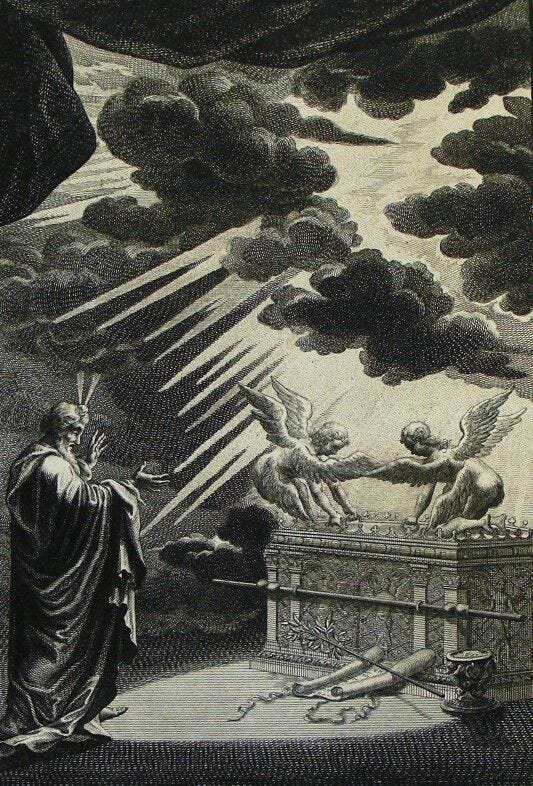
As I surveyed the use of “shadow” language in Scripture, particularly when it is used positively, I began to notice a certain directionality of the phrases and expressions. It seems that there is in most cases a movement from creature to Creator and not the other way around. For example, the Psalmist says, “Let me take refuge in the shelter of Your wings,” but God does not say, “Come and take refuge in the shelter of My wings.” This movement is indicative of volition: one dwells under God’s shadow precisely because that’s where they want to be. One might bring up the passage found in Matthew 23 in which Jesus states that He longed to gather your children together as a hen gathers her brood under her wings. Jesus is, of course, God, and so at first blush this does seem to counter my point, but this actually proves it. Notice: they were not willing! The shadow of God can only be the dwelling place of the willing, those who say “yes” to Him.
The New Testament Tabernacle
Now that we have a better understanding of the Tabernacle built by Bezalel and of shadow, we return to the time of our Lord. In St John’s thought, Jesus was this Tabernacle in its fullest, truest sense: the Tabernacle was where Jewish faithful could meet with God; Jesus actually IS God. Having in mind what we do about it’s construction and the necessity of a craftsman to build it, the next question presents itself: who built the New Testament Tabernacle? And the answer, of course, is the Blessed Virgin Mary.


Think of it! Bezalel was of the tribe of Judah; Mary, in Church Tradition and according to the apocryphal text The Protoevangelium of James, was of the family of David, and so was of the tribe of Judah. The same text tells us that she was twelve years old at the Annunciation of Gabriel in Luke 1 which would make her a woman of about thirteen at the birth of Jesus of Nazareth, just as Bezalel was twelve or thirteen at the completion of his Tabernacle.
Bezalel is the first person the Scriptures say was filled with the Spirit; Blessed Mary is the first person to, by the Spirit, bring forth a Child from her virginal state. Only hands prepared and consecrated by God’s Spirit could build the Tabernacle; only a virgin prepared and consecrated by God’s Spirit could birth Jesus.
And just as Bezalel’s name means “under the shadow of God”, Gabriel announced that Mary would be what by God? Overshadowed. She would be under the shadow of God! But not until she had expressed her volition, her cosmic “Yes” to Him.
Indeed, Bezalel typifies and anticipates the Blessed Virgin, and we now rejoice in the Marian Tabernacle, built by an obscure girl from the tribe of Judah who was chosen, prepared and commissioned by God not to simply build a tent, but to lend her own flesh to the God of Abraham, Isaac, and Jacob so that He might dwell among us. Mary, fulfilling the vocation of Bezalel, teaches us what it means to say “yes” and rest under God’s shadow, becoming tabernacles ourselves: the dwelling place of God on earth.
How is Mary’s life instructive to our own? What do we learn about what we must do in light of Bezalel and the Marian Tabernacle? To answer this, I make one last turn to the Acts of the Apostles to find practical instruction.
Pentecost and Mary
After our Divine Lord ascended into heaven and the angels gently spoke some sense into the slack-jawed disciples, we are told that Mary and the Apostles, together with about a hundred others, were together in the Upper Room engaged in the only activity that made sense at this juncture: Prayer. And it was in this room, where in one accord the faithful labored in a spirit of prayerful devotion, that the sound of a mighty rushing wind filled their ears, tongues of fire divided and rested on each of them, and they were all filled with the Holy Spirit (Acts 2:4).
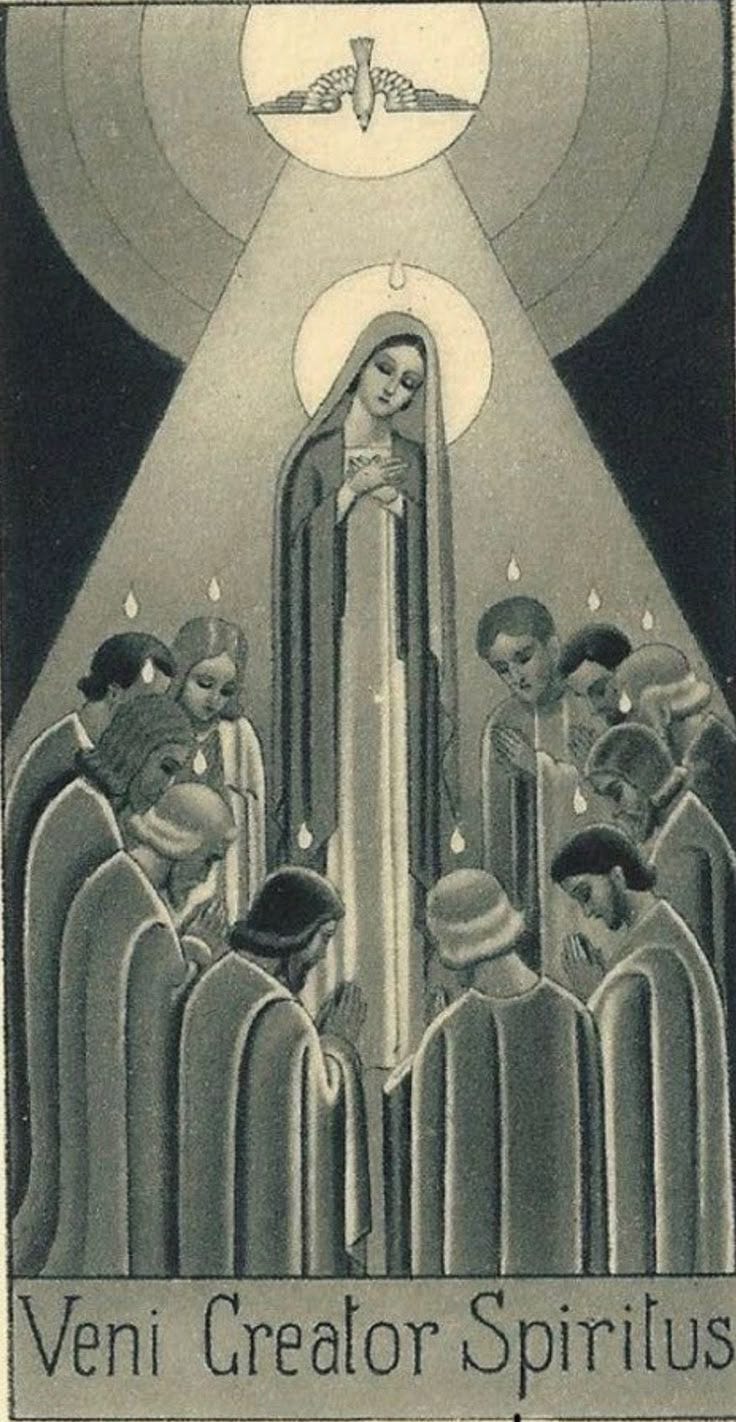
If we look close here, we may find a pattern that we recognize: they are volitionally engaged in prayer, after which they are overshadowed and filled with the Holy Spirit. Indeed, this is nothing less than the Annunciation of Mary all over again! Mary was called, she gave her “yes”, she was overshadowed and filled with the Spirit of God, she built the tabernacle; the disciples were called by Jesus to wait for Him, they gave their “yes” (being in prayer together as a corporate response to their Lord’s calling), they were overshadowed and filled with the Spirit of God, and then Peter preaches and three-thousand are added to their numbers that very day.
Of course, the Tabernacle had already been built, so I don’t believe that this could be called the construction of the NEW New Tabernacle. If we remember that Bezalel’s Tabernacle eventually gave way to the Temple, it makes sense that the new Tabernacle of Jesus’ flesh also gives way to a New Temple: the Church. This is the construction that Peter engaged in upon his being filled with the Spirit and that we now continue.
Subsequent to the Pentecost event, the Marian and Apostolic pattern was set as we see in Acts 2:42 where it is said that they continued steadfastly in the apostle’s doctrine and fellowship, the breaking of the bread and the prayers. The prayer that had lead to the descent of the Spirit on Pentecost was both fulfillment (of Bezalel and Mary) and precedent (of Acts 2:42). Anglican priest and English ascetical theologian Fr Martin Thornton calls this pattern the “threefold Regula”, the threefold rule of prayer by which we live into the life of the Trinity — Daily Office (the prayers), Mass (the breaking of bread), and Personal Devotion (the apostle’s doctrine and fellowship).
Conclusion
How is it that we live a life “under the shadow of God” as Bezalel prefigured and as Mary demonstrated? Pentecost paints a clear picture that is instructive for the Church: by willingly praying according to the Apostolic pattern of the threefold Regula — by being under Rule. We pray in the person of the Son, by the power of the Spirit, in praise of the Father; we partake in the Body and Blood of Christ at the Mass; we are conformed to His life by the Spirit through devotion, and daily walk with Him to offer a sacrifice of praise to the Father in the Office.
It is from this life of Regular prayer that we, as living stones, are built up to be the Temple of the Holy Spirit, the dwelling place of God on earth to whom weary sojourners, traveling through the spiritual desert of the world, may go and meet with the Living God. From Bezalel’s Tabernacle to the Marian Tabernacle and now to the Church-Temple, God dwells with us, and in abiding under His shadow by way of Regular prayer as demonstrated by Mary and the Apostles, we make God available to the world and continue the noble, Spirit-empowered work — initiated by God in creation, continued in Bezalel, conceived in Mary, and now consummated by Christ in us — of building God’s Temple.
DiacoNate is the hammer of Bezalel. He does not miss.
Incredible work, my brother.